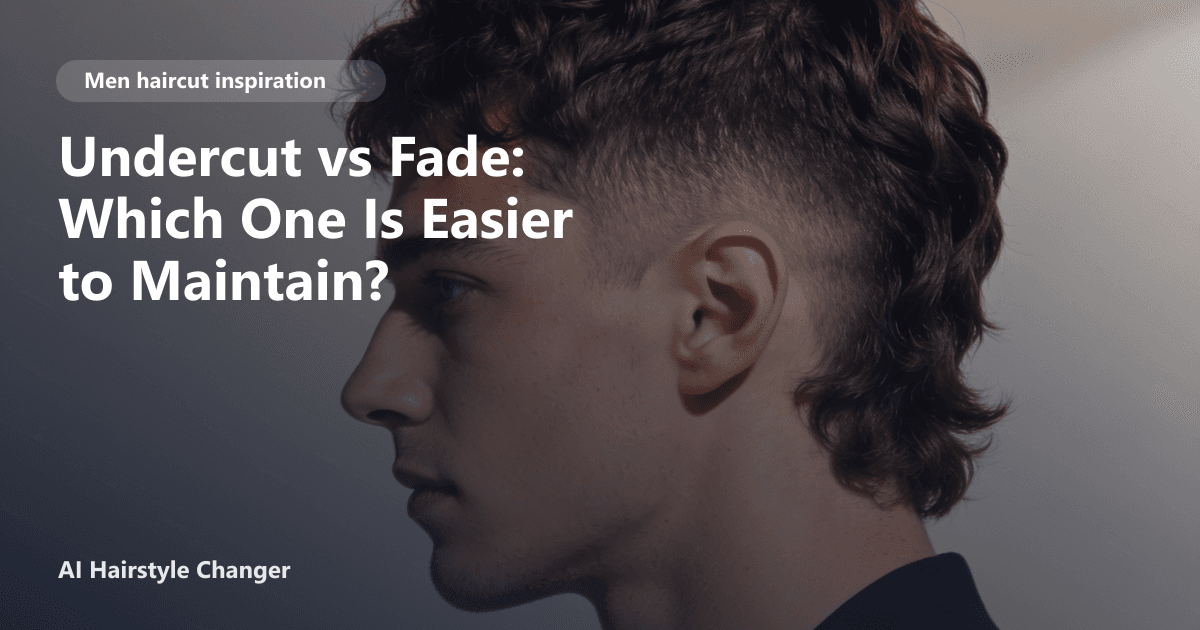
You're staring at the mirror, debating between an undercut and a fade for your next haircut. Both are sharp, modern, and everywhere right now - but which one will actually fit your lifestyle and be easier to maintain week after week? If you want a style that looks fresh without constant trips to the barber, making the right call matters. Let's break down the real-world upkeep, styling options, and who each cut suits best, so you can walk into your appointment (or open up AI Hairstyle Changer) with total clarity.
What Sets Undercuts and Fades Apart?
Both undercuts and fades are short on the sides and longer on top, but the difference is in the blending and shape. An undercut features a clear disconnect between the top and sides - think sharp contrast, like Cillian Murphy in "Peaky Blinders" or Zayn Malik's signature look. The fade, on the other hand, gradually blends hair from short to long, often with a skin-close finish at the bottom that tapers into the top length. Fades come in low, mid, and high variations, each changing the overall vibe.
Everyday Maintenance: Which Is Simpler?
Undercut Upkeep
- Growth: The hard line of an undercut makes regrowth obvious. Sides grow out bluntly, so the style loses its crispness within 2 - 3 weeks.
- Styling: The top needs daily styling - pomade, clay, or paste to keep it neat or textured. If you like slick-backs or quiffs, this is your playground.
- Salon Visits: Expect trims every 2 - 3 weeks to keep the sides sharp and the contrast clean.
Fade Upkeep
- Growth: Fades grow out more subtly. The blended sides mean you can stretch time between cuts to 3 - 4 weeks before it looks messy.
- Styling: The top can be short (buzz, crop) or longer (comb-over, pompadour). Shorter tops mean less daily maintenance.
- Salon Visits: Fades need a skilled barber, but you get more leeway between appointments, especially with a low or mid fade.
Bottom line: Fades are generally easier to maintain if you want a style that looks neat for longer between cuts. Undercuts require more frequent touch-ups, but offer more dramatic styling options.
Who Suits an Undercut?
Undercuts work best if you want to make a statement or love high-contrast styles. They flatter oval, square, and heart-shaped faces, especially if you keep volume on top. Guys with thick, straight, or wavy hair can pull off disconnected looks with ease. If you're after a slick-back, messy fringe, or even a modern mullet twist, the undercut is a flexible base.
What to ask your barber:
- Keep the sides clippered to a #1 or #2, with a hard disconnect line
- Top length: 3 - 6 inches for styling versatility
- Avoid: Too much weight on the sides or a top that's too short for your face shape
If you want to see how an undercut will look with your hair type and face, upload a photo to AI Hairstyle Changer and test classic, textured, or messy undercut variations before you commit.
Who Suits a Fade?
Fades are universally flattering and can be tailored to any hair type or face shape. The low fade is subtle and professional, the mid fade balances sharpness and versatility, while the high fade is bold and edgy. Fades pair well with buzz cuts, crops, pompadours, and even curly tops.
What to ask your barber:
- Fade height: low, mid, or high, depending on your comfort with exposure
- Side length: skin, #0, or #1 at the base
- Top length: match to your styling preference - short for easy care, longer for volume
- Avoid: Uneven blending or abrupt transitions
Curious how a low taper fade works with your hair? Check out Low Taper Fade for Straight Hair: Best Variations and Styling or Low Taper Fade for Curly Hair: What to Ask Your Barber for detailed tips.
Four Concrete Haircut Directions
1. Classic Undercut
- Sides: Clippered to #1 or #2, disconnected from the top
- Top: 4 - 6 inches, slicked back or textured
- Upkeep: High - needs trimming every 2 - 3 weeks
- Works for: Straight or wavy hair, bold style
2. Textured Crop Fade
- Sides: Mid or high fade, #0 - #2
- Top: 1 - 2 inches, choppy or messy
- Upkeep: Low - easy to style and grows out well
- Works for: Most hair types, especially fine or thick
3. Buzz Cut with Skin Fade
- Sides: High skin fade, blended into the buzz
- Top: #1 - #3 all over
- Upkeep: Very low - just a quick run-over every few weeks
- Works for: Anyone wanting minimal maintenance; see Buzz Cut Guide: Lengths, Face Shapes, and Variations
4. Modern Mullet Undercut
- Sides: Disconnected undercut, short or faded
- Top/Back: Longer at the back, shorter at the front
- Upkeep: Moderate - needs shaping every 3 - 4 weeks
- Works for: Wavy or curly hair, statement styles
Styling and Product Tips
- Undercuts: Use matte clay for texture or pomade for shine. Blow-dry for volume. Avoid heavy gels that weigh hair down.
- Fades: For crops or buzzes, a touch of light cream keeps things neat. Longer tops can handle mousse or sea salt spray for movement.
- Barber talk: Bring reference photos (print or phone), specify your fade height or disconnect line, and clarify how much length you want to keep on top.
- Try-on advantage: With AI Hairstyle Changer, you can visualize these styles, adjust the length, and see how a fade or undercut frames your actual features.
When Each Style Fails
- Undercut: Looks awkward as it grows out if not trimmed often. Can appear too harsh on round faces or with thinning hair.
- Fade: A bad fade looks patchy or uneven. High fades can feel too exposed for some, and curly hair can be tricky to blend without the right barber. For curly options, see Hairstyles for Curly Hair Men: Best Cuts by Length.
How to Decide: Fade or Undercut?
If you want a bold, high-contrast look and don't mind regular trims, go for the undercut. If you prefer a style that grows out gracefully, needs less frequent upkeep, and can adapt to any hair type or length, the fade is your friend. Still unsure? Use AI Hairstyle Changer to try both styles with your own photo, compare side-by-side, and shortlist your favorites to show your barber.
Table: Maintenance and Style Comparison
| Style | Upkeep Frequency | Styling Effort | Who It Suits | Fails When |
|---|---|---|---|---|
| Undercut | Every 2 - 3 weeks | Medium - High | Oval, square, thick | Grows out bluntly, too harsh |
| Fade (Low/Mid) | Every 3 - 4 weeks | Low - Medium | All hair types/faces | Bad blending, patchy |
| Buzz + Fade | 4+ weeks | Very Low | All, esp. busy men | No contrast, lacks volume |
| Mullet Undercut | 3 - 4 weeks | Medium | Wavy, curly, bold | Poor shaping, mullet grows |
FAQ
Is a fade or undercut better for thick hair?
Both work, but a fade can help reduce bulk and blend thick hair more naturally. Undercuts can look dramatic with thick hair, but require more upkeep to keep the sides sharp.
How often should I get an undercut or fade trimmed?
Undercuts need a touch-up every 2 - 3 weeks to keep the disconnect crisp. Fades can stretch to 3 - 4 weeks, especially if you go for a low or mid fade.
Can I combine a fade with an undercut?
Absolutely. Many modern styles blend a faded side into a disconnected undercut for a hybrid look. Bring reference photos and discuss the transition line with your barber.
How can I see if a fade or undercut suits my face?
Upload your photo to AI Hairstyle Changer. You can try different fade heights, undercut variations, and even mullet combos to see which flatters your features before you book your appointment.
Takeaway: Try Before You Cut
Choosing between an undercut and a fade comes down to your lifestyle, hair type, and how much time you want to spend on maintenance. Both styles have their strengths and potential pitfalls. Before you commit, use AI Hairstyle Changer to test drive the exact look you want - then head to your barber with confidence and a clear vision. Ready to find a style that fits you? Explore more at Find a Style That Fits You.