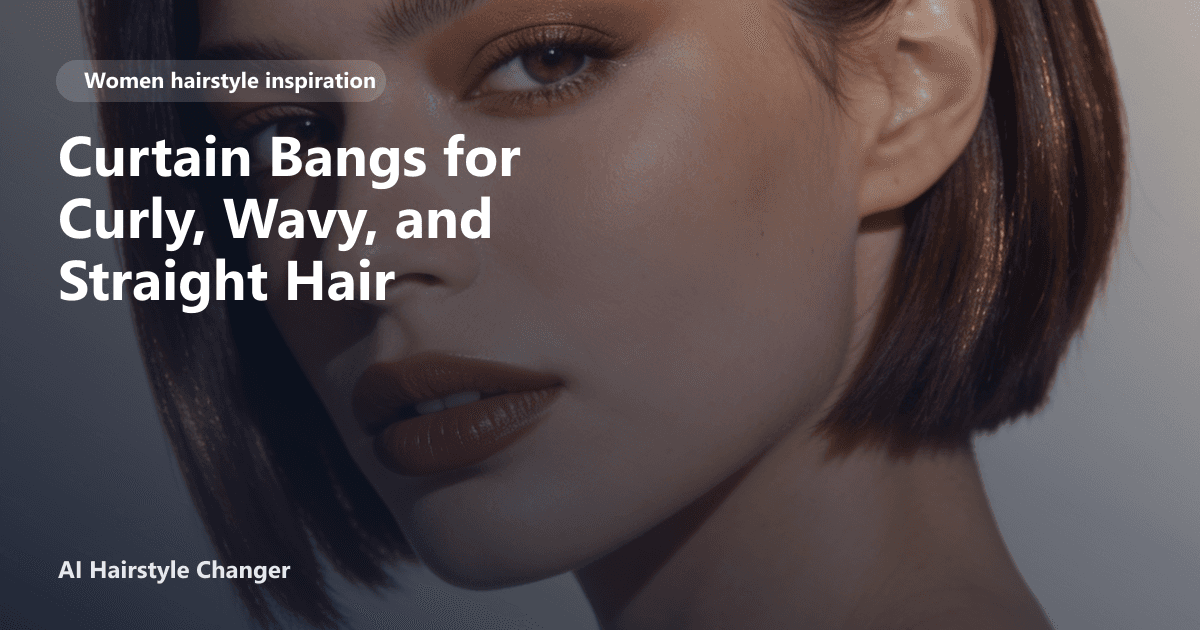
You're staring at a photo of curtain bangs that look effortless - perfectly parted, framing the face just so - and wondering if your hair can actually do that. The answer depends entirely on your texture. Curtain bangs behave differently on straight, wavy, and curly hair, and choosing the wrong approach for your type leads to daily styling battles or a cut that falls flat within days.
What Curtain Bangs Actually Are (and Why Texture Changes Everything)
Curtain bangs are parted down the middle and swept to each side, creating a face-framing effect that blends into the rest of your hair. Unlike blunt bangs, they grow out gracefully and offer styling flexibility. But texture dictates how they fall, how much work they require, and whether they'll give you that soft, intentional look or just look like grown-out bangs you didn't ask for.
The density of your hair matters as much as the curl pattern. Fine straight hair falls limp without the right internal layers. Thick curly hair can turn into a triangular helmet if the length and weight aren't balanced properly. Before you book, understand what your texture needs.
Hair texture also affects how much length you lose to shrinkage. Curly hair can spring up 30-50% shorter when dry, while wavy hair might shrink 10-20%. Straight hair shows the true length immediately. This is why dry-cutting is non-negotiable for curly textures and recommended for wavy hair. Whether your hair is long or short, texture remains the primary factor - see Curtain Bangs for Short Hair: What Actually Works for length-specific advice.
Curtain Bangs on Straight Hair: The Classic Blueprint
Straight hair shows every cut line, which makes precision crucial. The benefit? You get the cleanest, most true-to-reference version of curtain bangs. The challenge? There's no texture to hide mistakes or add natural volume.
Who it suits best: Oval, heart, and long face shapes. If you have fine, straight hair, you'll need extra attention to avoid wispiness that disappears by midday.
What to ask for: Request bangs that start at the bridge of your nose and taper to cheekbone length. The center should be shortest, with a gradual lengthening toward the sides. Ask your stylist to point-cut the ends rather than blunt-cut - this creates softness and movement. For fine hair, ask for internal layering at the roots to add volume without visible layers.
Specific styling routine: Apply a volumizing mousse to damp bangs, then blow-dry with a medium round brush. Direct hair away from your face, rolling the brush forward and back to create bend. Finish with a cool shot to set the shape. For second-day hair, mist with water, re-part, and blow-dry for 2 minutes. This takes 5-10 minutes daily.
Product recommendations:
- Fine straight hair: Living Proof Full Thickening Mousse, Oribe Dry Texturizing Spray
- Thick straight hair: Redken Velvet Gelatine 07, Kristin Ess Dry Finish Working Texture Spray
Maintenance reality: You'll need trims every 4-5 weeks to keep the shape. Straight hair shows regrowth immediately, so schedule ahead.
When it fails: If you have very fine, silky straight hair and a round face, curtain bangs can emphasize width instead of length. In that case, a longer, side-swept variation works better. Check our guide to Curtain Bangs for Long Hair: The Best Ways to Wear Them for face-framing strategies that add vertical lines.
Curtain Bangs on Wavy Hair: The Sweet Spot
Wavy hair gives you the best of both worlds - natural volume and easy styling. The texture does half the work, creating that effortless, beachy curtain effect without heat.
Who it suits best: All face shapes, especially square and round. The waves add softness and movement that balances stronger jawlines and adds dimension to flatter profiles.
What to ask for: Keep the length slightly longer than straight hair - nose to chin-length works well. Ask for dry-cutting or a combination of wet and dry cutting so your stylist can see your natural wave pattern. The center should be shortest, but the transition to longer pieces needs to be subtle to avoid a sudden weight drop that creates a shelf effect.
Styling approach: Air-dry with a salt spray or light curl cream, scrunching the bangs upward to encourage the wave pattern. If you diffuse, cup the bangs in the diffuser bowl on low speed to maintain their shape. For more defined waves, twist each side away from your face while damp. This takes 3-5 minutes of hands-off styling.
Product recommendations:
- Light waves: Ouai Wave Spray, Bumble and bumble Surf Spray
- Stronger waves: Moroccanoil Curl Defining Cream, Davines Love Curl Cream
Maintenance reality: Trims every 5-6 weeks. Wavy hair hides grow-out better than straight, so you have more leeway between appointments.
When it fails: If your waves are inconsistent - some pieces straight, some tightly coiled - the bangs can look uneven. A skilled stylist can work with this by cutting each wave clump individually, but you need to be realistic about your natural pattern. For shorter wavy styles with bangs, see Curtain Bangs for Short Hair: What Actually Works.
Curtain Bangs on Curly Hair: The High-Reward Challenge
Curly curtain bangs deliver major impact but require the most expertise to cut. The shrinkage factor means length and spring must be calculated precisely, and the wrong technique creates a puffy, unmanageable fringe.
Who it suits best: Oval and heart shapes. Round faces can work if the bangs are cut longer and the curls are elongated rather than tight. The key is creating vertical lines that counteract width.
What to ask for: Insist on a curly-hair specialist who cuts dry. The bangs should be cut at their natural curl length, not stretched. Ask for the center to hit just above the brow when dry, tapering to cheekbone. The key is removing weight from the underside so curls don't puff outward into a triangle. Ask for 'invisible layering' or 'carving' to thin bulk without losing length.
Understanding shrinkage: If your stylist cuts wet, you could end up with bangs that spring up 3-4 inches shorter than intended. Bring reference photos of curly curtain bangs on hair with your exact curl pattern (3A, 3B, 4A, etc.).
Styling approach: Apply curl cream to soaking wet hair, then scrunch upward. Air-dry or diffuse on low speed, high heat. Don't touch the bangs while drying - this prevents frizz and maintains the part. Once 100% dry, you can gently separate curls with oil on your fingertips. Styling time: 10-15 minutes.
Product recommendations:
- For definition: DevaCurl SuperCream, Pattern Curl Gel
- For frizz control: Ouidad Advanced Climate Control Gel, Kinky-Curly Knot Today
Maintenance reality: Trims every 6-8 weeks. Curly bangs grow out visibly, but the texture helps blend the length into face-framing pieces.
When it fails: If you have very tight coils or a strong curl pattern that naturally clumps together, curtain bangs can require daily styling to maintain the part. Some curl patterns resist that separated curtain effect and prefer to form a unified wave. Test this before you cut by using our AI Hairstyle Changer to see how your curl pattern interacts with the style.
The Universal Rules: Face Shape, Density, and Styling
Regardless of texture, these factors determine success:
Face shape adjustments:
- Round faces: Keep bangs longer, below cheekbones, to create vertical lines. Avoid starting the part too wide.
- Square faces: Soften the edges with wispy, textured ends. A slightly off-center part helps.
- Heart faces: Shorter center pieces balance a wider forehead. Keep sides longer to draw attention down.
- Long faces: Wider parting and shorter length add width. Avoid making the bangs too piecey.
Density matters more than you think:
- Fine hair: Needs internal layers and root lift products. Without this, bangs disappear.
- Thick hair: Requires weight removal and thinning to avoid a bulky fringe that overwhelms your face.
- Thinning hair: Keep bangs wispier and longer to avoid exposing scalp at the part.
Styling products by texture:
| Hair Type | Primary Product | Second-Day Refresher |
|---|---|---|
| Straight | Volumizing mousse | Dry shampoo + water mist |
| Wavy | Salt spray or light cream | Water + scrunch |
| Curly | Curl defining cream | Leave-in conditioner spray |
If you're pairing bangs with a bob, consult our Bob Haircut Guide: Types, Face Shapes, and Maintenance to ensure the lengths work together. For fine hair bobs specifically, see Best Bob Haircuts for Fine or Thin Hair.
How to Test Curtain Bangs Before You Commit
The biggest mistake is committing to bangs based on a photo of someone with completely different hair. You need to see it on your face, with your texture, from multiple angles.
Upload a selfie to AI Hairstyle Changer and test curtain bangs at different lengths and textures. The tool adjusts for your hair type, showing you realistic results rather than a generic overlay. You can shortlist three variations to show your stylist - this eliminates miscommunication and gives you a reference for length, density, and styling.
Try the style on photos taken in different lighting and angles. What looks good straight-on might feel too heavy in profile. The tool lets you compare side-by-side, so you know exactly what you're asking for before you sit in the chair. Test both center parts and slightly off-center parts to see what flatters your face shape most.
FAQ
Will curtain bangs make my round face look wider?
They can if cut too short. For round faces, keep the longest pieces at or below your jawline. This creates vertical length that slims. Ask your stylist to cut the bangs dry so you can see exactly where they'll hit when styled. A slightly off-center part also helps break up circular symmetry.
How often do I really need to trim these?
Every 4-6 weeks depending on texture. Straight hair shows growth fastest (4 weeks). Curly hair can stretch to 6-8 weeks because the texture disguises length changes. Set a recurring appointment when you get the initial cut - it's easy to let it slide and lose the shape. Wavy hair falls in the middle at 5-6 weeks.
Can I style curtain bangs without heat?
Yes, especially with wavy or curly hair. For straight hair, you can wrap damp bangs around large velcro rollers and let them air-dry. Another trick: part them while wet, clip each side to your temples with duckbill clips, and let them dry in place. This gives gentle bend without a round brush. For waves and curls, simply scrunch and air-dry.
What if I hate them - how long to grow out?
About 3-4 months to reach chin length, where they blend into face-framing layers. The grow-out is actually easier than blunt bangs because the parted style transitions naturally into longer pieces. During the awkward phase, twist them back with bobby pins, use a decorative clip, or braid them into a crown. The center-parted shape means they grow out symmetrically.
Curtain bangs work on every hair type, but the cut and styling must match your texture. The difference between a style you love and one you regret isn't the bangs themselves - it's whether they were designed for your specific hair reality. Test the look, bring references, and communicate your texture needs clearly to your stylist. Ready to see how curtain bangs look on you? Try AI Hairstyle Changer and preview your perfect length before you book.